Yoga with Kaya Resources
  • About
  • SRY
    • Online Followup for Teachers
    • Online Followup for Teachers
    • Audio SRY Practice with Kaya
    • SRY Fundamentals Course
    • Sharing SRY
    • Agni and Soma Home Study
    • YTT in SRY
  • Ayurveda
    • Join Agni and Soma Nutrition
    • Tridoshic Food List
    • Ayurveda Application
    • Ayurveda Followup
    • Yogify
  • Māyurveda
    • Māyurveda Intake
    • Early Pregnancy
    • Mayurveda Conception Client Pages
    • Māyurveda Prenatal Client Pages
    • Mayurveda Postpartum Pages >
      • Kids Ayurveda
  • Work with Me
    • Retreat Intake
    • Training / Mentoring Intake
    • One on One Intake
  • Audio
    • Shavasana
    • Bhagavad Gita Essentials
  • Contact
    • Resources

Knowledge Heals

About Kaya

Shavāsana - A Neutral & Healing Position

11/30/2014

1 Comment

 
Picture
Shavāsana may be the most familiar pose to you! We do it every yoga class, in some styles, twice in every class... why is this? What are the benefits of the "king of yoga poses", and how much do you really know about the pose that you may do the most often and most consistently in any and every yoga class you've ever attended? Here's a deeper look at it's purpose and potential for the body, mind and self-awareness...  

 “Lying flat on the ground with the face upwards, in the manner of a dead body, is Shavāsana.  It removes tiredness and enables the mind [and whole body] to relax.” – Hatha Yoga Pradipika
Picture
The Meaning
Shavāsana means "corpse pose" and is the best pose for total physical rest and relaxation.  Because physical death is an ultimate kind of "letting go", this name signifies the level letting go that is possible in this pose. Because death (and deep sleep) is also associated in the yoga tradition with a resolving of one's ego-identity (I am this, or that), Shavāsana is also considered an opportunity to dive into the pure being-ness that has no individual identity. 

The Spine & Shavasana
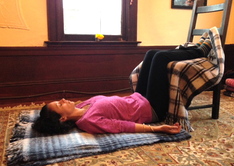
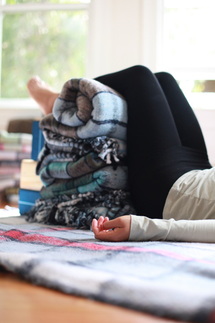
In restorative classes, you learn to elevate your legs.  This is because, with your legs flat on the earth, you get a big arch at the back of your waist (lumbar area), which puts a great deal of pressure on your spine and your internal organs.  PLUS, this arch in your spine can keep your mind busy, rather than quiet.  When you elevate your legs while lying on your back, your waist comes down toward the earth.   This gives you more physical ease and comfort, takes the pressure off of your torso, and supports your mind in becoming peaceful.  This is also why you may need to prop your head.  If your neck is arched (due to spinal tension) in Shavasana (your chin is higher than your forehead) this puts a great deal of pressure on your neck, throat and skull and also keeps your mind active.  In this case, you prop under your head (not your neck) until your forehead is level with your chin.  Again, this supports your body to be at ease and your mind to relax. 

Subtle Architecture of Reclined Poses
The wisdom of design and arrangement in the vedic tradition is called, Vāstu.  It can be applied to your body and yoga poses as well as artwork and design and architectural structures such as a home, temple or office.  In this tradition, different directions or lines (called rekhas) are associated with different qualities.  A horizontal line - like a reclined or supine pose in which you are lying down) brings certain kinds of qualities.  
  • Sleep
  • Rest
  • Relaxation
  • Heaviness
  • Groundedness
  • Earthiness
  • Slowness

Horizontal lines (such as reclined poses) in excess can over emphasize some of these additional qualities:
  • Sickness
  • Lethargy
  • Dullness
  • Darkness

So you can see, the great value of Shavasana (and other reclined poses) in helping you rest, relax, ground, and slow down!  You can also start to understand the importance of balancing that with other directions of movement and angles - such as seated and standing poses. 

Picture
A well supported, restorative shavāsana

Benefits of Shavāsana

Benefits of Shavasana
When you deeply relax, as can happen in Shavasana, and physical and mental tensions dissolve, some of these benefits take place: 
  • Improves circulation
  • Increases cellular respiration
  • Increases and improves the flow of prāna (life force) - get even more of this with Ujjayi Prānāyāmā
  • Progressively relaxes all of the muscles of the body and can decompress the spine
  • Quiets the mind
  • Potential for the experience of yoga nidra (yogic sleep state)
  • Stimulates the parasympathetic response
  • Promotes peace and joy
  • Increases one’s capacity for awareness 
  • Draws the mind inward (called pratyahara in the yoga tradition)
  • Reduces fatigue and restores of energy
  • Can reduce blood pressure and peptic ulcer
  • Reduces stress
  • Clearing of psychosomatic diseases and neuroses. 
  • Resolution of latent impressions buried in the unconscious mind that can be the underlying cause of dis-ease 

The Best Time to Do Shavāsana

Preparation Shavāsana - If you start your yoga practice with shavasana, the pose offers an opportunity to land in your body, recover from your wordly activity and stimulation and quiet the mind in preparation for your yoga practice. This kind of pre-yoga-shavāsana helps you arrive in the present moment and in your body.  It also is a time to recover from whatever exhaustion, stress and drama you brought with you when you arrived in the yoga room.  This kind of relaxed preparation will actually deepen the effects of the yoga practices that follow. 

Marination Shavāsana - If you end your yoga practice with shavāsana, it serves the purpose of allowing you time in a neutral position to abide and marinate in all the inner openings - body, mind and more - of the yoga practice you've just done.  The openings continue for you even after you complete the poses, the more so if you are in Shavasana. This allows the openings to last longer, and to make an imprint on you so that more and more, openness, ease, and inner quietude become natural to you. 

So When to do Shavasana?
  • On it's own, as a transition to start or complete your day. 
  • At the beginning or end of your yoga practice (or both)
  • In the middle of the day as a pick-me-up, instead of a nap
  • Anytime you feel tired or tense!
1 Comment
New Jersey Fetish Scene link
11/9/2022 02:32:34 pm

Great reading your blog ppost

Reply


Leave a Reply.

    Author

    Yoga Therapist, Ayurvedic Practitioner & Mama - these articles are to support your yoga practice with knowledge and inspiration. 

    Categories

    All
    Ayurveda
    For Teachers
    Health & Healing
    Heart Opening
    Home Practice
    Kaya's Story
    Pose Notes
    Self Care
    Sequencing
    Vedic Principles
    Yoga & Mind
    Yoga's Purpose

    RSS Feed

Kaya is the founder of SRY™ which is based in the full spectrum of the Vedic yoga tradition. She has been teaching therapeutic restorative yoga therapy since 2001. Kaya's work is healing, transformative, deeply rejuvenating and empowers her student and clients with wisdom and inner experience. Her trained in the full spectrum of the Vedic Tradition includes Yoga, Yoga Therapy, Prenatal Yoga, Ayurveda, Women's Health, Eastern Anatomy, Sanskrit, Vedic Astrology and Vedanta Philosophy. She collaborates with her husband Michael Manzella, a Vedic Astrologer, to serve yoga students and teachers who are inclined toward depth of inner experience and knowledge.  MORE ON KAYA
  • About
  • SRY
    • Online Followup for Teachers
    • Online Followup for Teachers
    • Audio SRY Practice with Kaya
    • SRY Fundamentals Course
    • Sharing SRY
    • Agni and Soma Home Study
    • YTT in SRY
  • Ayurveda
    • Join Agni and Soma Nutrition
    • Tridoshic Food List
    • Ayurveda Application
    • Ayurveda Followup
    • Yogify
  • Māyurveda
    • Māyurveda Intake
    • Early Pregnancy
    • Mayurveda Conception Client Pages
    • Māyurveda Prenatal Client Pages
    • Mayurveda Postpartum Pages >
      • Kids Ayurveda
  • Work with Me
    • Retreat Intake
    • Training / Mentoring Intake
    • One on One Intake
  • Audio
    • Shavasana
    • Bhagavad Gita Essentials
  • Contact
    • Resources